| Main Page - Back |
|
From SudokuWiki.org, the puzzle solver's site |

Guardians
As of March 2010 this strategy has been deprecated. It is a complicated way of looking at what is ultimately a nice loop with off-chain eliminations. It has been removed from the solver. The documentation will remain on this site.
(a.k.a. Broken Wings, Turbot-Fish)
This strategy works with single numbers.
We've already used closed loops of conjugate pairs to find things like X-Wings and Swordfish. X-Wings contains 4 cells in a perfect rectangle. Swordfish requires 6 or 9 cells in a grid. This strategy works with odd numbers of pairs in a loop starting with 5. There are several varieties depending on how 'perfect' the loop is.
Let us use the words perfect pair instead of conjugate pair to mean any number that exists only twice in one unit (row, column or box). This means we can use imperfect to mean a number that occurs three or more times in a unit. (Obviously if it only occurred once it would solve that cell).
Credits: I want to thank Rod Hagglund for explaining this technique although for Type 1 Single Guardians (this first example) Singles Chain might be simpler logic. Some of the Type 2 and Type 3 Guardians can also be attacked with Multi-Colouring but I've not discovered how with the two examples below.
(a.k.a. Broken Wings, Turbot-Fish)
This strategy works with single numbers.
We've already used closed loops of conjugate pairs to find things like X-Wings and Swordfish. X-Wings contains 4 cells in a perfect rectangle. Swordfish requires 6 or 9 cells in a grid. This strategy works with odd numbers of pairs in a loop starting with 5. There are several varieties depending on how 'perfect' the loop is.
Let us use the words perfect pair instead of conjugate pair to mean any number that exists only twice in one unit (row, column or box). This means we can use imperfect to mean a number that occurs three or more times in a unit. (Obviously if it only occurred once it would solve that cell).
Credits: I want to thank Rod Hagglund for explaining this technique although for Type 1 Single Guardians (this first example) Singles Chain might be simpler logic. Some of the Type 2 and Type 3 Guardians can also be attacked with Multi-Colouring but I've not discovered how with the two examples below.
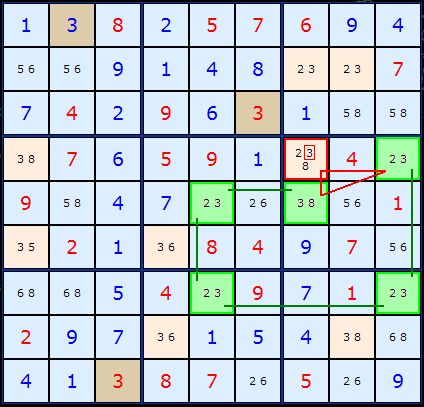
R5C7 - R5C5 - along the row
R5C5 - R7C5 - along the column
R7C5 - R7C9 - along the row
R7C9 - R4C9 - along the column
To close the loop we have an imperfect triplet in the sixth box.
The question is: can a closed loop of five candidate cells be constructed with each cell perfectly-paired in two ways with the next linking cells in the loop? The answer is no. Such a formation is impossible in a Sudoku puzzle. In such a loop, if you "placed" a candidate in any one of the cells and followed the consequences around the loop, you'd generate an automatic contradiction - forcing the number to disappear entirely from a row, cell or block, or to appear twice in a single line or block, depending on how you proceed.
(Note: You have to turn off Simple Colouring, Remote Pairs, XY-Chain, BUG and Forcing Chains).
To repeat, In an actual Sudoku there can never be a closed loop of five perfectly paired cells. And that is exactly where the solving technique lies. Any such structure must have one or more cells that disrupt the perfect pairings. We can refer to the cells which prevent one of the pairings from being perfect as guardians. Here's the trick: logically, one or more of the guardians
must contain the candidate number. If none of the guardian cells were real, then the pairings would all be perfect and, as was already noted, that is flat-out impossible in a valid Sudoku. Accordingly, we can make the following assertions:
The variants of this strategy depend on how many Imperfect connections there are in the loop. To achieve one guardian there must be four perfect pairs and one Imperfect
connection. Figure 1 illustrates this. That one guardian is the cell that disrupts the 5-loop from being perfect.
must contain the candidate number. If none of the guardian cells were real, then the pairings would all be perfect and, as was already noted, that is flat-out impossible in a valid Sudoku. Accordingly, we can make the following assertions:
- If there is only one guardian cell, the candidate number can be installed in that cell.
- If there is more than one guardian, any cell that is seen by all the guardian cells cannot contain the candidate number; hence
- If all the guardian cells are in a single column, row or block of the Broken Wing, the candidate can be erased from both the Broken Wing cells in that column, row or block.
Type 1 - Single Guardians
The variants of this strategy depend on how many Imperfect connections there are in the loop. To achieve one guardian there must be four perfect pairs and one Imperfect
connection. Figure 1 illustrates this. That one guardian is the cell that disrupts the 5-loop from being perfect.
Type 2 - Double Guardians
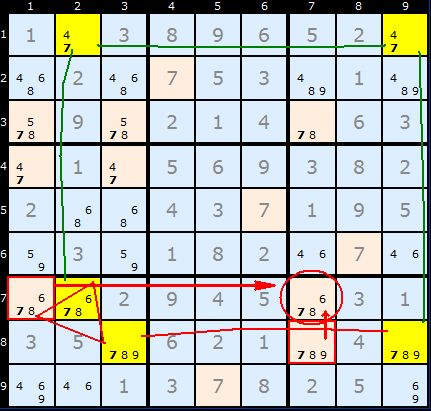
R8C3 - R8C9 - along the row
R8C3 - R7C2 - within the box
This gives us two guardian 7's in R7C1 and R8C7 marked in red squares. Whatever cells these two can both 'see' we can eliminate the 7 from them. Since in this example they form the opposite corners of a rectangle we can safely remove the 7 from R7C7 marked in a red circle. The other corner, R8C1,
contains a solved square.
Solving R7C7 allows us to complete the puzzle using other strategies.
Type 3 - Disruptive Guardians
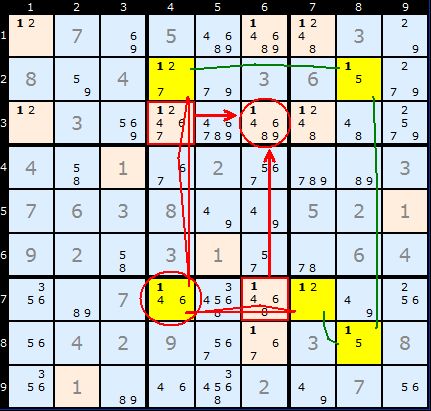
R2C4 - R7C4 - along the column
R7C4 - R7C7 - along the row
This gives us two guardian 1's in R3C4 and R7C6 marked in red squares.
Whatever cells these two can both 'see' we can eliminate the 1 from them. Like in the example above, they form the opposite corners of a rectangle but the difference is that we're eliminating a 1 that's actually part of the loop. This is perfectly legitimate and follows from Rule 3 described above. The elimination occurs because R7C4 can be seen by both guardians.