| Main Page - Back |
|
From SudokuWiki.org, the puzzle solver's site |

Multi-Colouring Strategy
This strategy has been deprecated and is not in the solver as in all tested cases a simpler strategy can be used to by-pass this one. There is some mileage in considering the interaction of two X-chains (ie chains on just one candidate number) but the complexity of doing so pushes this approach way down the priority list. It is retained here as an acedemic exercise.
There are two major types of Multi-colouring and neither are for the faint hearted.
You'll need four coloured pencils ;-)
Fortunately we are only scanning the board for single numbers in conjugate pairs. These occur where a candidate exists only twice in any row, colum or box (unit). We can chain these togther if there are sufficient numbers of them just as we did for simple colouring above. In Multi-Colouring we are looking for two or more chains. It is important they don't link up - three or more appearances of the candidate number in an intervening unit prevent the 'link up' of two chains.
Given two chains we can label them A and B. A+ and A- will indicate the alternating states so that EITHER all of A+ are true OR all of A- are true. We don't know which way round yet. Similarly B+ and B- indicate alternating true/false for that chain. C+ and C- continues the theme if there are more chains on the same candidate number. Give A+, A-, B+ and B- we can colour them on the board to see the patterns.
Type 1 Multi-Colouring
The Rule is as follows: If A+ shares a unit with B+ and B- then A+ must be the false candidate since either B+ or B- must be true.
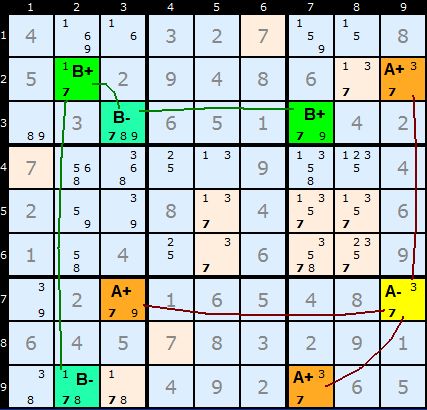
Now, the yellow cell marked A- does not share a unit with any of B cells. However, all three cells marked A+ can see a B+ or a B- in one or more shared units. Since the solution cannot be both B+ and B- but must be at least all of B+ or all of B- every cell in A+ must be false and number 7 can be removed from all A+ cells.
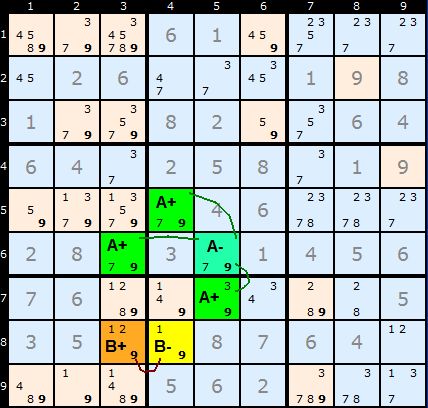
Interestingly, although B can be a chain of just two cells A must be a longer chain. Otherwise we'd be in a situation where the Sudoku has two solutions or multi-colouring can be reduced to a Unique Rectangle.
Type 2 Multi-Colouring
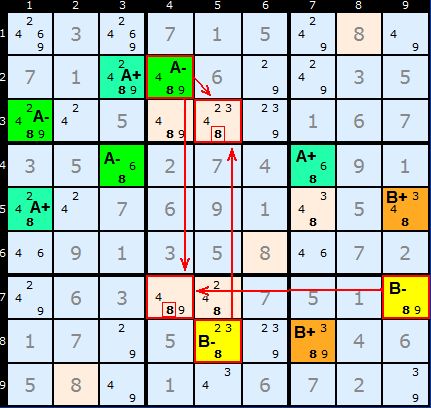
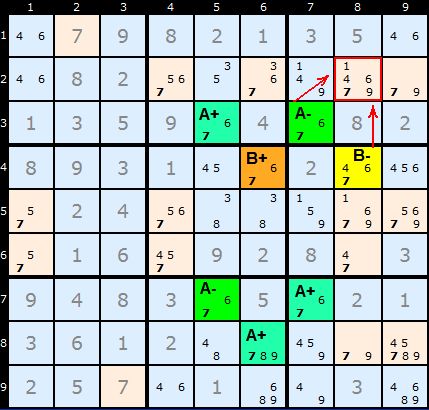
If A+ shares a unit with B+ then any cell with the given candidate and sharing a unit with both A- and B- can have that candidate excluded. The Reason: Since A+ and B+ can't both be true, then either one or both of A- and B- must be true. Therefore any cell sharing a unit with both A- and B- can safely have that candidate excluded.
If A+ shares a unit with B+ then any cell with the given candidate and sharing a unit with both A- and B- can have that candidate excluded. The Reason: Since A+ and B+ can't both be true, then either one or both of A- and B- must be true. Therefore any cell sharing a unit with both A- and B- can safely have that candidate excluded.
Multi-Colouring with 3+ chains
I don't have an example of a Sudoku requiring a multi-colouring solution using three or more chains.
I'd be very grateful for an example.
I don't have an example of a Sudoku requiring a multi-colouring solution using three or more chains.
I'd be very grateful for an example.