| Main Page - Back |
|
From SudokuWiki.org, the puzzle solver's site |

Pattern Overlay
Invented by Myth Jellies, this strategy looks at the way candidates of a specific digit N can be distributed in the remaining spaces. Every time a digit is placed it removes other spaces in the rest of the row, column and box, quickly narrowing down the possibilities. It is a strategy you don't want to apply too early in the puzzle since the number of overlays might be too large, but in the middle and end games it is fairly easy to apply.
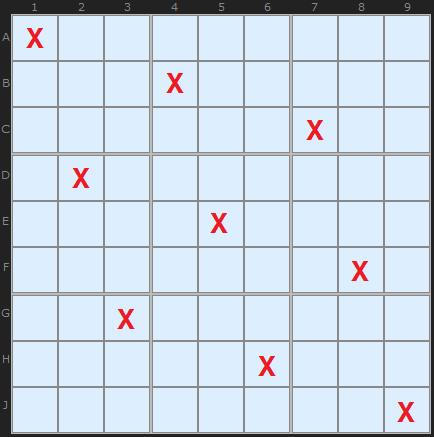
The first diagram shows a possible pattern or template. It is in fact the first such pattern given an empty board and placement from top left to bottom right. On an empty board there are 46,656 different patterns which is why we use this when most cells are filled. Every placement of N reduces the number of patterns by a factor of 9.
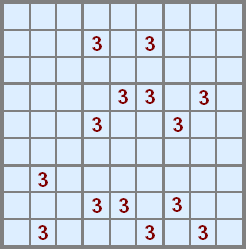
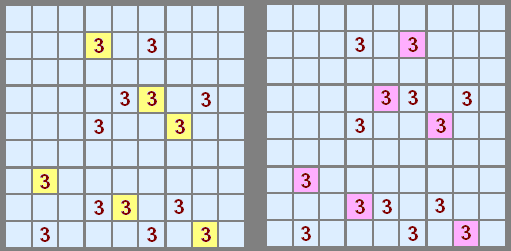
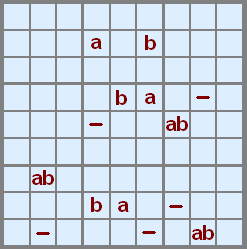
The solver will return one of two types of elimination sets, which it calls "Rule 1" and "Rule 2"
Rule 1 considers each number in isolation. When looking for all the possible patterns for X it is possible that X may not appear in any pattern at all. If found, the solver reports and quits.
Rule 2 looks at all the patterns for all numbers 1 to 9. Within in each number all patterns may want to occupy certain cells - like a bottleneck. If that is the case then those cells are not available for other patterns used by other numbers. This is more cumbersome for a human to calculate, admittedly, but it works very well for the solver and we get a lot of this type. Patterns are pruned down and then Rule 1 is executed to find the first X where cells not used by X. Only the first X is reported - there may be other eliminations from numbers higher than X but it would be too confusing to report the total overlap.
The logic of POM ensure that there will always be at least one pattern for every X despite all these operations - unless the puzzle itself is faulty.