| Main Page - Back |
|
From SudokuWiki.org, the puzzle solver's site |

X-Cycles (Part 2)
So far, I been looking at X-Cycles which alternate perfectly all the way round. There are two interesting rules that lead to eliminations when we identify an imperfection in a loop which is called a discontinuity.
A discontinuity occurs when we find two strong links next to each other (that is, with no weak link between them) or two weak links next to each other (with no strong link dividing them). These rules work only if there is exactly one discontinuity, and such a loop will always have an odd number of nodes.
'Discontinuity' doesn't mean that the loop is broken or that it's not chain; it refers only to the imperfection that would otherwise make links alternate strong/weak/strong, and so on.
A discontinuity occurs when we find two strong links next to each other (that is, with no weak link between them) or two weak links next to each other (with no strong link dividing them). These rules work only if there is exactly one discontinuity, and such a loop will always have an odd number of nodes.
'Discontinuity' doesn't mean that the loop is broken or that it's not chain; it refers only to the imperfection that would otherwise make links alternate strong/weak/strong, and so on.
Nice Loops Rule 2
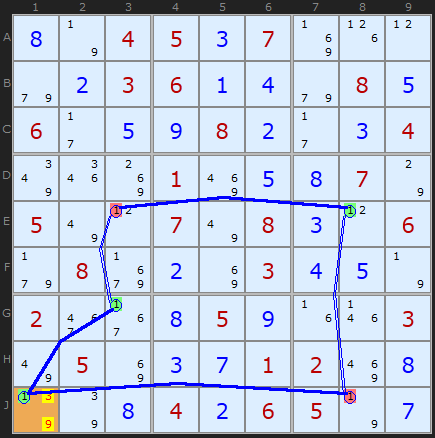
If the adjacent links are links with strong inference (solid line), a candidate can be fixed in the cell at the discontinuity.
This rule allows us to know the solution of a certain cell absolutely, no matter how many other candidates there may be on that cell. Unlike the case of the first Nice Loop rule, we are not looking at a mass of eliminations outside the loop; instead, this rule tells us something about the loop itself. Let’s look at an example before examining the logical proof.
For discontinuous X-Cycles, the notation always starts with the discontinuity. In Figure 1, our Nice Loop on number 1 is:
X-CYCLE on 1 (Discontinuous Alternating Nice Loop, length 6):
-1[J1]+1[G3]-1[E3]+1[E8]-1[J8]+1[J1]
- Contradiction: When 1 is removed from J1 the chain implies it must be 1 - other candidates 3/9 can be removed
We have two strong links joined at J1; therefore, J1 is 1. One way to make sense of this logically is to trace round the alternative. If J1 was not a 1 G3 and J8 would have to be 1s. That would remove the candidate 1 from E3 and oblige E8 to be a 1. But hang on - that forces two 1s in column 8. A contradiction so the 1 must exist in J1.
Nice Loops Rule 3
Our third rule dictates what happens when two weak links form a discontinuity in a loop:
If the adjacent links are links with weak inference (broken line), a candidate can be eliminated from the cell at the discontinuity.
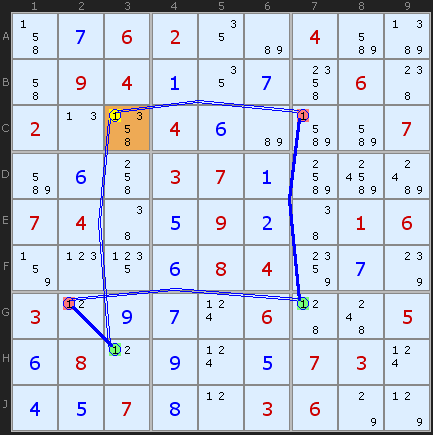
The solver would return this message:
X-CYCLE on 1 (Discontinuous Alternating Nice Loop, length 6):
+1[C3]-1[C7]+1[G7]-1[G2]+1[H3]-1[C3]
- Contradiction: When C3 is set to 1 the chain implies it cannot be 1 - it can be removed
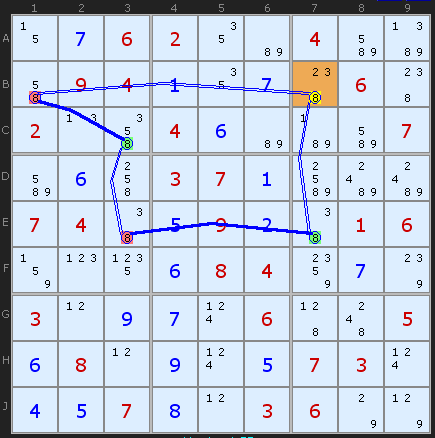
X-CYCLE on 8 (Discontinuous Alternating Nice Loop, length 6):
+8[B7]-8[B1]+8[C3]-8[E3]+8[E7]-8[B7]
- Contradiction: When B7 is set to 8 the chain implies it cannot be 8 - it can be removed
Weak and Strong Links
X-Cycles introduced the idea of Weak and Strong links but I want to make a more precise definition of terms since there are subtleties which will be useful in other chaining strategies. The rough and ready distinction between Strong and Weak links is to do with how many candidates are in a unit – namely, Strong links are formed when only two are present, while three or more imply a Weak link.
From a strong link we can infer that
if not A, then B
From a weak link, we can infer only that
if A then not B, C, D according to how many candidates there are in a unit
This implies that:
However, the following is also true that for a strong link:
if A, then not B
So, some Strong links can be reversed to give us a "link with weak inference" - if the occasion calls for it. It is perfectly logical to assert on a unit with two candidates of X both:
In Figure 5 we have an array of 6 candidates on a board. A number of strategies can show that the 6 on H9 can be eliminated. I have coloured some cells using Simple Colouring Rule 2 which link up some pairs on the board - either all of the yellow cells will be 6 or all of the cyan cells will be 6. Since H9 can see C9 (yellow) and H5 (cyan) it cannot be a 6 since it can see cells with both colours.
From a strong link we can infer that
if not A, then B
From a weak link, we can infer only that
if A then not B, C, D according to how many candidates there are in a unit
This implies that:
- Strong links are "links with strong inference"; and
- Weak links are "links with weak inference".
However, the following is also true that for a strong link:
if A, then not B
So, some Strong links can be reversed to give us a "link with weak inference" - if the occasion calls for it. It is perfectly logical to assert on a unit with two candidates of X both:
- If Not A then B (!A =>B)
- If A then Not B (A => !B)
In Figure 5 we have an array of 6 candidates on a board. A number of strategies can show that the 6 on H9 can be eliminated. I have coloured some cells using Simple Colouring Rule 2 which link up some pairs on the board - either all of the yellow cells will be 6 or all of the cyan cells will be 6. Since H9 can see C9 (yellow) and H5 (cyan) it cannot be a 6 since it can see cells with both colours.
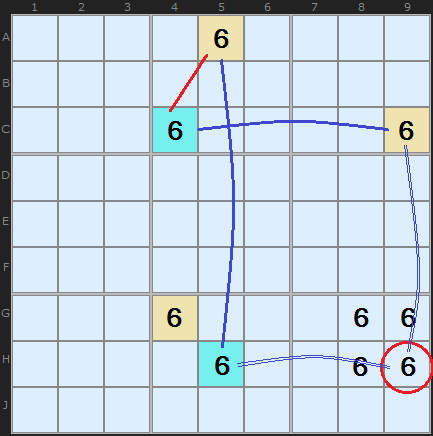
If a strong link can have weak inference, then let’s just change the link from C4 to A5 to imply such. Simple. We get our pattern. If 6 is on C4, then it is not on A5 (weak inference), or if it is on A5, then it is not on C4 (also weak inference – and all very logical).
I have coloured the Strong link with weak inference red in Figure 5.
X-Cycle Exemplars
These puzzles require the X-Cycle strategy at some point but are otherwise trivial.They also require just one Naked Pair.
They make good practice puzzles.