| Main Page - Back |
|
From SudokuWiki.org, the puzzle solver's site |

Cell Forcing Chains
Forcing Chains are a powerful extension of chain strategies. Given that a cell or unit contains certain numbers, and that these are the only alternatives, we can show that certain candidates must be eliminated. Specifically we show that *all* of the alternatives must eliminate the target. The chains force the removal as no alternative exists.
Dual Cell Forcing Chains
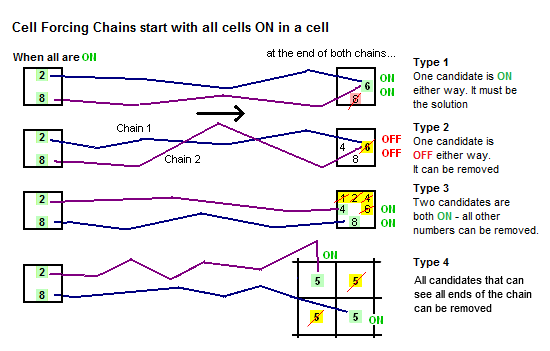
Note: All these example can be found in the solver only by unchecking Forcing Nets
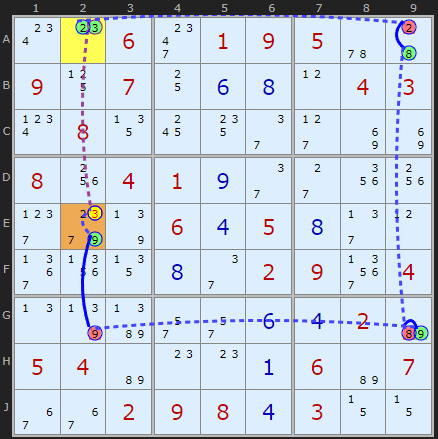
In this example, we can eliminate 3 in E2 because of the numbers 8 and 9 left in A2. The small purple chain shows makes the obvious case that if A2 is 3 then E2 cannot be.
The 2 in A2 takes a longer journey: it bounces to +8A9 to +9 in G9 giving -9 in G2 and the strong link forces 9 in E2 to no 3.
Since we are arguing from a single cell and the cell has two candidates, this is the simplest Forcing Chain, a Dual Cell Forcing Chain.
Note: Dual Cell Forcing Chains are not found by the solver because the solver will find AICs or Digit Forcing Chains first. The reason is that one of the two candidates that would make a Dual Cell Forcing Chain would be part of the chain on the Digit Forcing Chain. In this example perhaps the 2 in A2 would be considered first. Then -2[A2] would imply +3[A2] and the chain continues with the same consequences. Dual Cell Forcing Chains are documented here as an alternative approach as as part of a family sequence. The example above can be artificially induced by unticking AIC and DFC in the solver.
Triple Cell Forcing Chains
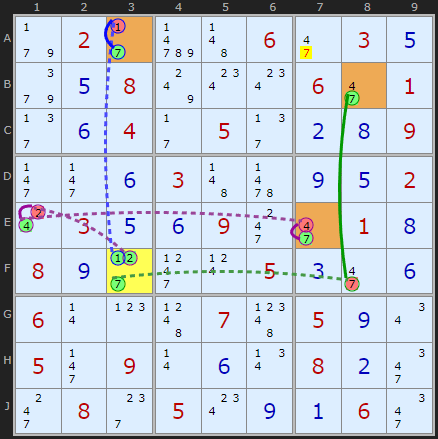
The second chain in purple +2[F3]-2[E1]+4[E1] -4[E7]+7[E7] is one chain link longer: The 2 in F3 must remove the 2 in E1 making it 4 which implies 7 in E7. That also removes 7 from A7. A lot of bi-value cells makes this example relatively easy but Forcing Chains can plough through denser boards.
Now to force 7 in F3 to remove the 7 in F8 and because of the Strong Link to B8 We don't need the other candidate in F8. The third +7 means all three options in F3 remove 7 from A7
In red, the chain starts with a 9 in D1 (+9). Removing the 9 in H1 means the 9 must be in H9 as its the last in the row. If that is the case we must remove the 9 from E9. E9 is interesting as it forms part of an Almost Locked Set with D8. An ALS is a set of N cells with N+1 candidates, in this case {3,5,9}. But by removing the 9 from E9 we have reduced an Almost Locked Set to a Locked Set. A 2-cell locked set is a Naked Pair. 3 and 5 must exist in D8 and E9 - we just don't know which way round yet. If this is the case then 3 can't exist in D7.
Voila, we have forced 3 from D7 using the contents of D1.
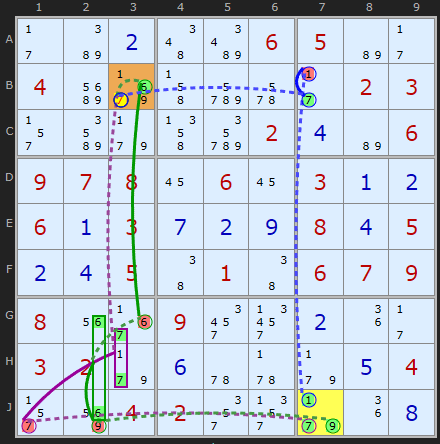
The purple chain, +7[J7]-7[J1]+7[G3|H3]-7[B3] contains an interesting group, symbolised by +7[G3|H3]. All this means is that if J1 is not a 7 then G3 OR H3 must be. If one of those must be 7 we can look along their alignment - the column, and remove 7s, eg 7 in B3.
The last chain, +9[J7]-9[J2]+6{J2|G2}-6[G3]+6[B3]-7[B3] contains an ALS, which I described above. We have a {5,6,9} in two cells GJ2. Removing 9 from J2 leaves a locked set of 5/6 in that box. All other 6 can be removed, namely the 6 in G3.
Note: The ALS on the purple chain is a fork and we chose to follow 7. If we follow 1 we can also remove 1 B3 as well pretty much using the same Cell Forcing Chain setup. This is the next step in the Solve Path.
Type 4
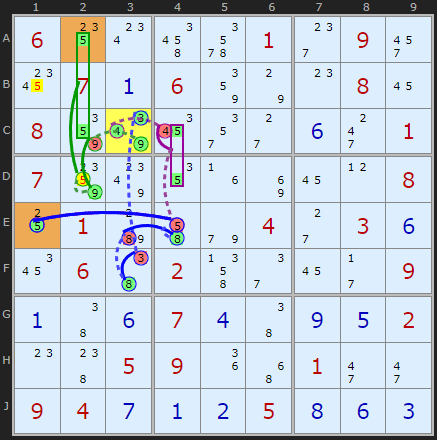
In this example all three candidates 3,4 and 9 are activated on call C3. Each activation creates a chain which happens to set +5 ON in AC3 and E1. We ask "what candidates around the board can see all those 5s?" Which ever is the solution to C3 it turns one of them on. 5s in B1 and D2 are vulnerable.
Type 4: All three candidates in C3 make chains which end in +5, so candidates that can see all chain ends can be eliminated:
- 5 can be removed from B1
- 5 can be removed from D2
+3[C3]-3[F3]+8[F3]-8[E3]+8[E4]-5[E4]+5[E1]
+4[C3]-4[C4]+5{C4|D4}-5[E4]+5[E1]
+9[C3]-9[C2]+9[D2]-5[D2]+5[A2|C2]
Quad Cell Forcing Chains
Logic relentlessly obliges us to consider the Quad formation, although I have not and will not look for higher order forcing chains, although they are possible. Quads are pretty rare. I found 6 in a random stock of forty thousand puzzles.
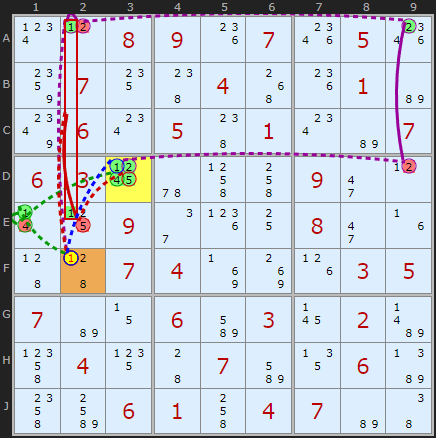
If there is a 1 in D3 it follows that
+1[D3]-1[F2]
If there is a 2 in D3 it follows that
+2[D3]-2[D9]+2[A9]-2[A2]+1[A2]-1[F2]
If there is a 4 in D3 it follows that
+4[D3]-4[E1]+1[E1]-1[F2]
If there is a 5 in D3 it follows that
+5[D3]-5[E2]+1{E2|A2}-1[F2].