| Main Page - Back |
|
From SudokuWiki.org, the puzzle solver's site |

Swordfish Strategy
With X-Wings we looked at a rectangle formed by four numbers at the corners. This allowed us to exclude other occurrences of that number in either the row or column. We can extend this pattern to nine cells and achieve even more eliminations.
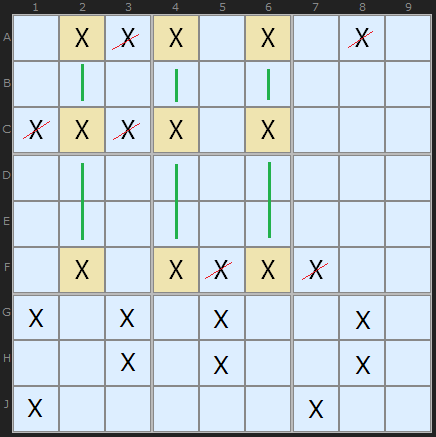
A Swordfish is a 3 by 3 nine-cell pattern where a candidate is found on three different rows (or three columns) and they line up in the opposite direction. Eventually we will fix three candidates somewhere in those cells which excludes all other candidates in those units.
The shaded cells show the Swordfish where X is unique to three cells in columns 2, 4 and 6. They are aligned on rows A, C and F. This means we can remove all candidate X in the other positions on those rows.
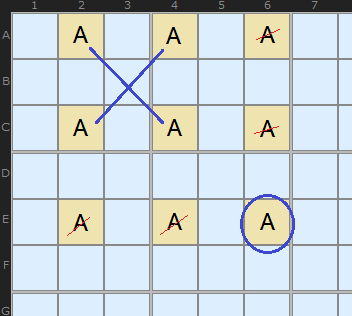
If you are not convinced that the shaded cells really must contain the solutions we can argue this way. All Swordfishes will break down into X-Wings and because we know X-Wings work, so will the Swordfish.
Take this arrangement of candidate A and let’s pretend that E6 is the solution. We ‘remove’ the rest of A in column 6 and row E. That leaves a X-Wing in AC24.
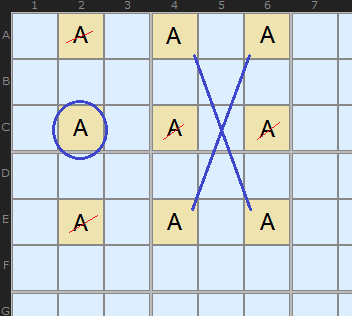
So all cells in the 3 by 3 grid are ‘locked’ together.
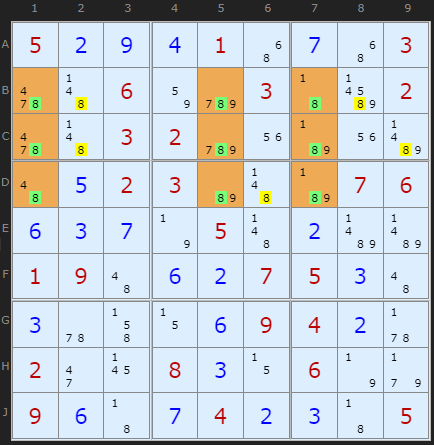
To match theory with practise the first example is a perfect 3-3-3 Swordfish, so called because all three candidates in each column are present (that is, no solved 8s in the pattern). The green numbers are the Swordfish cells. The yellow numbers are those cells where 8 can be removed.
A perfect Swordfish is extremely rare. This one is provided by Klaus Brenner who found it in the newspaper La Libre Belgique. (Turn Rectangle Elimination off)
If you remember how Naked and Hidden Triples work you'll remember that they require three numbers in three cells - in total. It's not necessary for every number to be in all three cells. So it is with the Swordfish.
Swordfishes come in a number of variations depending on the number of X present in the nine cells that make up a Swordfish. With an X-Wing you need candidate X in all four cells of the 2 by 2 formation, but with the 3 by 3 Swordfish formation you don't need X in every cell - just as long as it is spread out over 3 by 3 cells. The next example has 9 twice in each column and is called a 2-2-2 Swordfish.
Swordfishes come in a number of variations depending on the number of X present in the nine cells that make up a Swordfish. With an X-Wing you need candidate X in all four cells of the 2 by 2 formation, but with the 3 by 3 Swordfish formation you don't need X in every cell - just as long as it is spread out over 3 by 3 cells. The next example has 9 twice in each column and is called a 2-2-2 Swordfish.
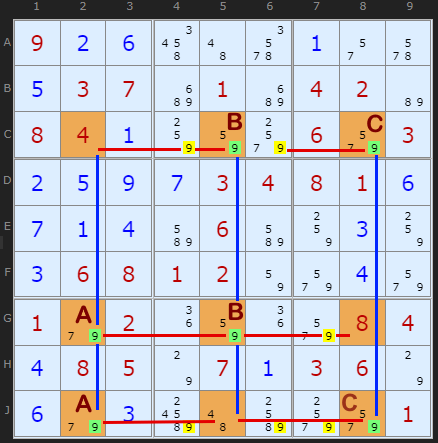
This is a 2-2-2 formation Swordfish in the columns and eliminates in the rows. I have labelled the three pairs AA, BB and CC which form each "2" in the name. Notice how they are staggered so that they still cover three columns. This is a minimal Swordfish but it does the job. We have six 9s that can go in one swoop.
(Turn Rectangle Elimination off)
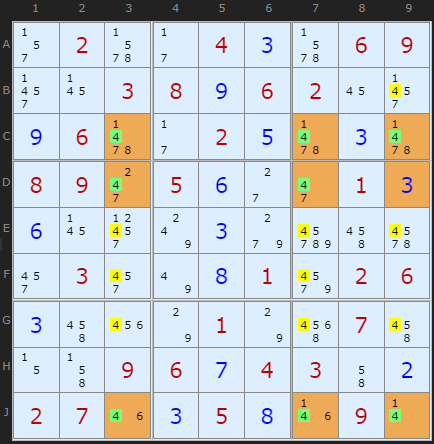
A Swordfish can be referred to by combining the row and columns numbers, which makes this example CDJ379. In formation terms it is 3-2-3.
(Turn Rectangle Elimination off)
Swordfish Exemplars
These puzzles require the Swordfish strategy at some point but are otherwise trivial or have other similar level strategies.
They make good practice puzzles.
(First 8 are new as of June 2025)
They make good practice puzzles.
(First 8 are new as of June 2025)