| Main Page - Back |
|
From SudokuWiki.org, the puzzle solver's site |

AIC with Groups
Grouped nodes were discussed on the Grouped X-Cycles page and it is very relevant to Alternating Inference Chains. Luckily, there’s nothing too scary about them although they may be harder to spot.
Note: Examples here will show up if Forcing Nets are turned off.
Note: Examples here will show up if Forcing Nets are turned off.
Rule 1 - Off-Chain Elimination
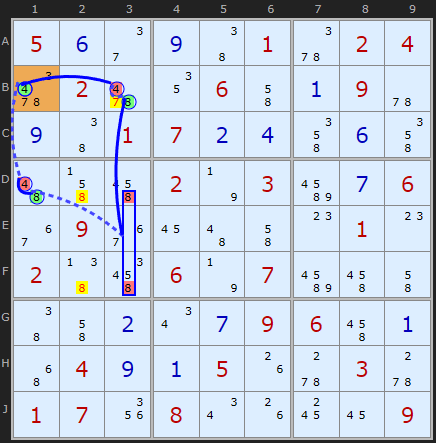
What makes this a 'Grouped' AIC chain is the double cell D3/F3. If you start with +8[D1] that potentially removes all other 8s in box 4. If that were so the only remaining 8 in column 3 is on B3. In order to make that link we combine D3 and F3 into a single pseudo-cell DF3. Note that if we use two or three cells in a group it has a specific orientation or alignment. It can only be useful in the direction the cells are aligned on. In this case it points along the column. The solver gives us:
AIC (w.Groups) Rule 1:
+4[B1]-4[D1]+8[D1]-8[D3|F3]+8[B3]-4[B3]+4[B1]
- Off-chain 8 taken off D2 - weak link: (8)D1 - to (8)D3|F3 =
- Off-chain 8 taken off F2 - weak link: (8)D1 - to (8)D3|F3 =
- Off-chain 7 taken off B3 - weak link between 8 and 4 in B3
Rule 2 - Strong Link Assertion
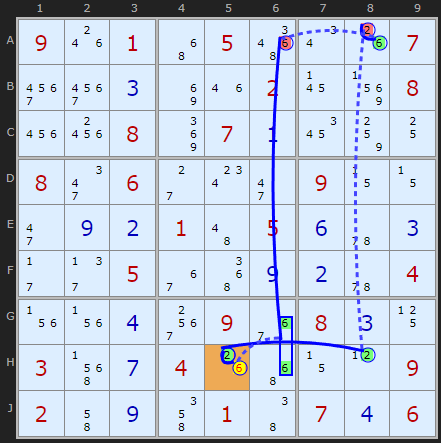
But making this a 'Grouped' AIC is the pseudo-cell GH6. If A6 is not 6 then one/either 6s in G6 or H6 must be ON. The orientation coming in from the column means we must continue the loop by looking in the box. We can turn OFF 6s there including H5. The logic on those links works in reverse as well, box to column. The solver gives us:
AIC on 2 ((w.Groups) Discontinuous Alternating Nice Loop, length 8):
-2[H5]+2[H8]-2[A8]+6[A8]-6[A6]+6[G6|H6]-6[H5]+2[H5]
- Contradiction: When 2 is removed from H5 the chain implies it must be 2 - other candidates 6 can be removed
Rule 3 - Weak Link Elimination
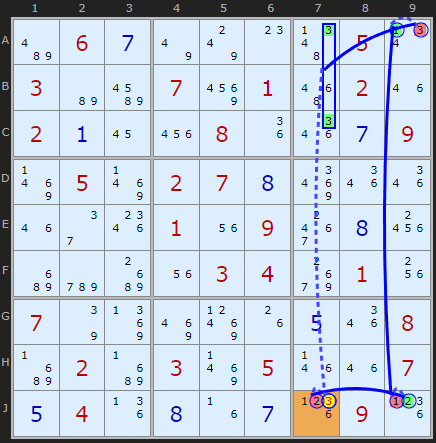
There is a very clear Grouped Cell in AC7. We can follow the solver's chain which comes in from the box and A3 with a -3. The 3s in AC7 are the only ones left in box 3 so we can combine them into a link cell if we follow their alignment down the column. This takes us to the -3 in J7.
To figure out we have a discontinuity we note we started with asserting J7 was 3 and the loop proves this assertion didn't work out. So the assertion was wrong and we can remove 3 from J7.
AIC on 3 ((w.Groups) Discontinuous Alternating Nice Loop, length 8):
+3[J7]-2[J7]+2[J9]-1[J9]+1[A9]-3[A9]+3[A7|C7]-3[J7]
- Contradiction: When J7 is set to 3 the chain implies it cannot be 3 - it can be removed