| Main Page - Back |
|
From SudokuWiki.org, the puzzle solver's site |

Tridagons
The Tridagon (a.k.a."Thor's Hammer") is a pattern first described by Denis Berthier and much developed on New Sudoku Player's Forum between 2022 and 2025. I have been reluctant at first to include it as it seemed contrived - relying on a spread of candidates that are very unlikely to appear in randomly created puzzles, let alone published ones. But people have generated long lists of puzzles where Tridagon is necessary and as this site is (partially) devoted to exploring the very hardest puzzles, I rolled up my sleeves and got stuck in. I am going to follow the outline given on Phil's Folly as it compresses the pattern down to it's essence and by-passes a lot of speculative development.
While it has a distinctive pattern it is a difficult strategy to prove logically. I've found Ryokousha's Cyclical Parity theory the most convincing (good links to further reading on the forum) and Rangsk's video on this very watchable.
The short version is this is a type of Deadly Pattern and we can use the extra candidates, the Guardians to make eliminations and avoid multiple solutions. The types listed here parallel the types laid out by Unique Rectangles.
Cyclical Parity

All six patterns are either rising or falling so we can think of their "parity". If rising they go 1 to 2 and 2 to 3 and 3 to 1 since it is "cyclical". Hence the theory talks of these boxes having "cyclical parity".
Next, for every set of three numbers we are interested in how to fill each stack (three vertical boxes) and band (three horizonal boxes). It is a property of Sudoku that
- All rising patterns have a different parity for the band and the stack
- All falling patterns have the same parity for the band and the stack

So how is this useful? If you have a rising pattern in box 4 (doesn't matter which, so drawing it in a line) and you have a rising pattern in box 1 – the diagonal – we are forced to consider a falling pattern for box 2. Which I've coloured in yellow. If we try another rising pattern there is no way to fit {1,2,3} into box 1 that doesn't cause a conflict.

To save the puzzle from having zero solutions some additional candidates are required to be present on one of the cells in the pattern. If there is one cell with any number of additional candidates that cell can have the triple removed from it. These extra candidates are called Guardians.
The pattern that stood out when first identified looked a little like "Thor's Hammer" so that is another name of this strategy.
Type 1 examples

Here is the first and classic example from Phil's Folly docs. I am breaking my rule about finding my own examples. I don't believe I can do that in a reasonable amount of time so I will pinch all the examples and provide a link instead.
There is a single 5 guardian in F6 which must be the solution to this cell.
It is not a difficult pattern to spot so the solver tries at the start of the 'diabolicals'. But I've bundled it under "various static patterns' as I don't think it will be discovered much outside the test lists.

Just to emphasis that the patterns within each box can be any of the three suitable for the parity. Not just straight diagonals.

It is important to appreciate the the triples are similar to Naked and Hidden Triples. In that it matters there are three numbers IN TOTAL across three cells, not that there are the same three numbers IN EACH cell. So while most examples will be {123} + {123} + {123} it could be as sparse as {12} + {13} + {23}.
Here is an example: 4 found to be the solution in C4.
Type 2 - Pointing Pair of Guardians

But if A and B are the same number they become a Pointing Pair. We can remove other candidates in the same box, and along the row and column if the pair are suitably aligned.
However the number of useful instances of this are very low. Running through a one Tridagon test file (monh_collection_until_230815conv2.txt) with 55,089 puzzles I identified 45,473 Type 1 patterns leading to an elimination while there were just 1,261 Type 2 - about %2.2.
Type 3a - Locked Pseudo-Pair
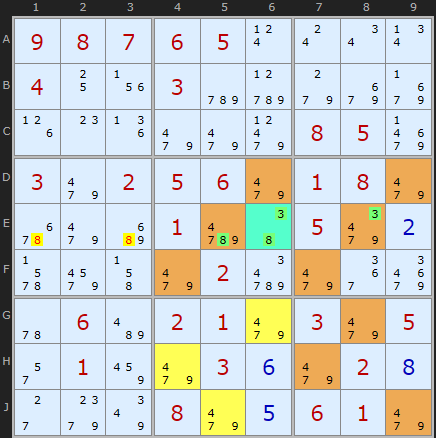
Here we have two guardians left living on the pattern but they have different values. 8 on E5 and 3 on E8. Because they are different they can't act like a Type 2 Pointing Pair. Instead we look for another cell containing just the 3 and 8. To avoid muliple solutions one, or other or both guardians must be true cell solutions. However the bi-value cell E6 would be emptied if they were both ON. Instead we can consider E6 as half of a locked pair with 8[E5] and 3[E8. If 3 and 8 are locked to those cells then any other 3 or 8 that can see all three cells cannot have those values. So 8 is removed from E13.
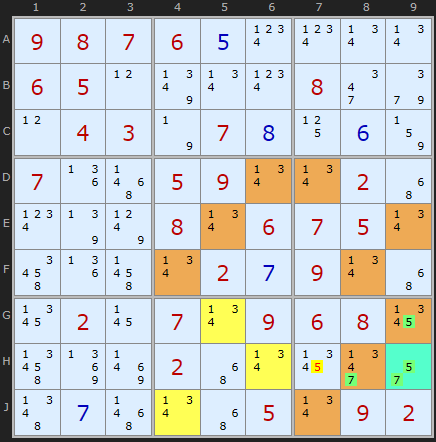
This example is aligned within the box rather than the row.
5[G9] and 7[H8] form a locked pseudo-pair with H9. Together they account for all the 5s and 7s in those three cells. That means 5 can be removed from H7.
Type 3b - Locked Pseudo-Triple
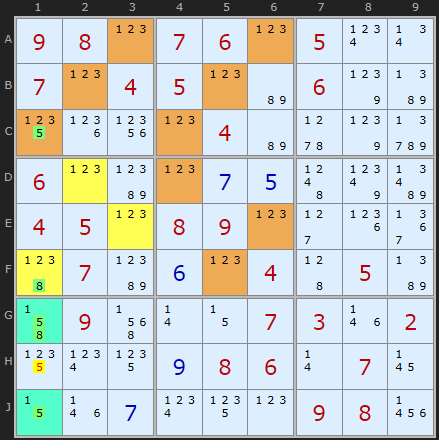
If something can be done with pairs it can usually be done with triples.
The 5 in C1 and the 8 in F1 can combine with two other cells and an extra candidate. These are 1/5/8 in G1 and J1. The 1 is necessary as triples involve three candidates. Our four-cell pseudo-triple is aligned in the column so that's where we look for extra 5s and 8s. This removes 5 from H1.
Type 4 and 5
Following the playbook set out by Unique Rectangles I have a hunch there could be Types 4 and 5. However I've not found examples.
Type 4: Exactly two pattern cells A,B that have extra guardian candidates and share a row or column. For each of the three Tridagon digits D, if D occurs only in A and B within that row/column, then the other two Tridagon digits can be deleted from A and B.
Type 5: Given two guardian cells A and B that do not see each other find a pattern cell C that sees both. If a triple digit D has strong links A-C and C-B, then the other triple digits that lack both strong links can be removed from A, B and C.
To find nothing means either I think the Tridagon pattern is so large is squeezes out places where they might have been if they were ordinary Unique Rectangles, or my algorithm is bad, or they don't exist - which requires a theory justification.
The Y-Wing version of type 3 I have not checked. Another 'type' I have not explored are the patterns under Hidden Unique Rectangles.
Beyond type 2 the hit rate rapidly declines. And if they do occur it is usually after many Forcing Nets or other strategies have opened the board allowing bi-value cells to exist. Also, as of time of writing the Tridagon pattern is searched for quite early in the 'extremes' list. However it is an interesting curiosity and worth documenting.
Results for monh_collection_until_230815conv2.txt
Puzzles:            55089
Type 1 found        45473
Type 2 found         1261
Type 3A found          65
Type 3B found          27
Type 4 found            0