| Main Page - Back |
|
From SudokuWiki.org, the puzzle solver's site |

Digit Forcing Chains
This is the start of a family of strategies called Forcing Chains. As the name implies they are made from chains - or formally - Alternating Inference Chains which are simple ON - OFF- ON - OFF consequences. Chains can start with an ON or an OFF. When a candidate X it turned 'on' it immediately turns 'off' all other candidates it can see. When a candidate is in the 'off' state it might turn on another candidate if there is only one left in the unit it can see.
In the strategy Forcing Chains we look at the consequences of a candidate being first ON and then OFF, or a group of candidates in a cell being ON (Cell Forcing Chains) or a number being ON in all instances in a unit (Unit Forcing Chains). If the consequences of the chains are identical - that another candidate is always ON or always OFF - then we can assert something about those candidates or immediate neighbours.
In the strategy Forcing Chains we look at the consequences of a candidate being first ON and then OFF, or a group of candidates in a cell being ON (Cell Forcing Chains) or a number being ON in all instances in a unit (Unit Forcing Chains). If the consequences of the chains are identical - that another candidate is always ON or always OFF - then we can assert something about those candidates or immediate neighbours.
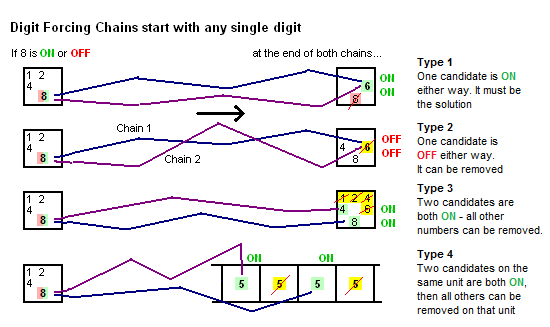
If the two ends of the chain meet on the same digit, the we can remove that digit if the ends are OFF, or it's the solution to that cell if the chain ends are both ON.
We can attack a whole cell by finding two ON digits. Then we know that one of those two ON cells is the solution, so any other candidates can be removed.
And finally, the unit attack, based on the same number appearing three or more times in that unit. You will see the pattern now. If we can find two numbers that the chain ends say must be ON, then one of them is the solution and the rest of that number X can be removed from the unit.
We can attack a whole cell by finding two ON digits. Then we know that one of those two ON cells is the solution, so any other candidates can be removed.
And finally, the unit attack, based on the same number appearing three or more times in that unit. You will see the pattern now. If we can find two numbers that the chain ends say must be ON, then one of them is the solution and the rest of that number X can be removed from the unit.
Note: All these example can be found in the solver only by unchecking Forcing Nets
Type 1 - Both chains lead to one candidate being ON
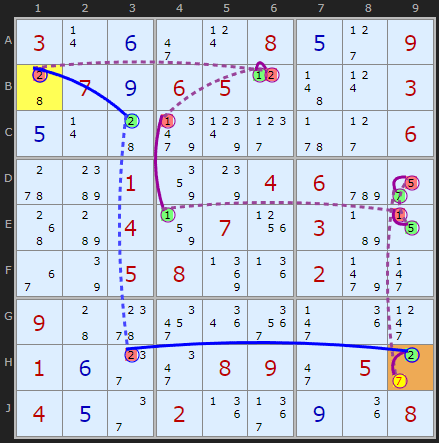
+2[B1]-2[B6]+1[B6]-1[C4] +1[E4]-1[E9]+5[E9]-5[D9] +7[D9]-7[H9]+2[H9]
Now, if the 2 in B1 were OFF we can trace another shorter chain (blue) to H9 were we also find the 2 can also be turned ON. The chain for this is
-2[B1]+2[C3]-2[H3]+2[H9]
So whether B1 is 2 or not, we know 2 will appear in H9 so the other candidate 7 can be removed and we get a solved cell.
Type 1 is pretty rare compared to other types but has more punch.
Type 2 - Both chains lead to one candidate being OFF
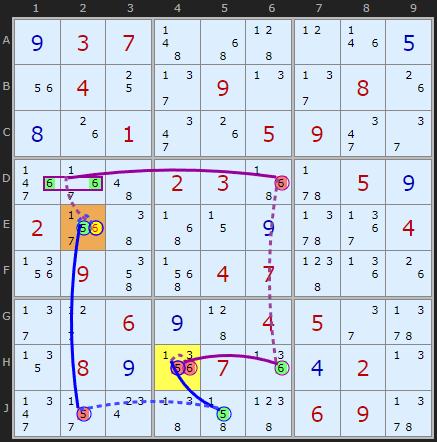
The first one is centred on 5 in H4. It finds that either way the 5 behaves it will disallow 6 in E2. Unlike type one this eliminates a single candidate - chipping away at the numbers left. But it is much more common.
So if -5[H5] we get this chain to -6[E2]:
-5[H4]+5[J5]-5[J2] +5[E2]-6[E2]
If +5[H5] we get the purple chain to -6[E2]:
+5[H4]-6[H4]+6[H6] -6[D6]+6[D1|D2]-6[E2]
No fancy links.
Type 3 - Both chains lead to TWO candidates being ON in a CELL
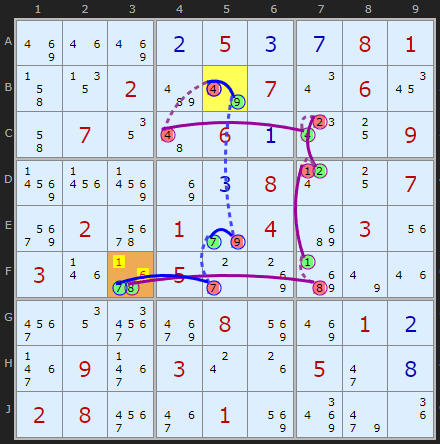
Starting with the shorter blue chain where 4 is OFF in B5 we arrive at F3 and must turn 7 ON as it is the last 7 in the row after -7[F5. The chain is
-4[B5]+9[B5]-9[E5]+7[E5] -7[F5]+7[F3]
The longer purple chain follows turning 4 OFF and it finds its way to F3 but wants to turn 8 ON instead. The chain is +4[B5]-4[C4]+4[C7]-2[C7] +2[D7]-1[D7]+1[F7] -8[F7]+8[F3].
So, in conclusion whether B5 is ON or OFF a 7 or a 8 fits in F3 - other candidates can be removed.
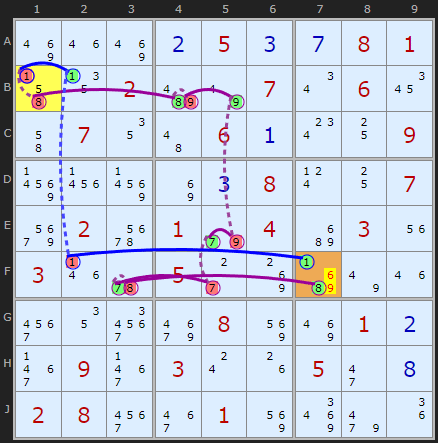
Let us take a peek at the second Digit Forcing Chain that comes immediately after the one above.
B1 is being favoured and the focus is on candidate 1. Following the chains we arrive at F7 where 1 and 8 are ON and possible solutions.
Type 3. Whether B1 is 1 or not the chains imply F7 must be [1 or 8] - other candidates 6/9 can be removed
-1[B1]+1[B2]-1[F2]+1[F7]
+1[B1]-8[B1]+8[B4]-9[B4] +9[B5]-9[E5]+7[E5]-7[F5] +7[F3]-8[F3]+8[F7]
Type 4 - Both chains lead to TWO candidates being ON in a UNIT
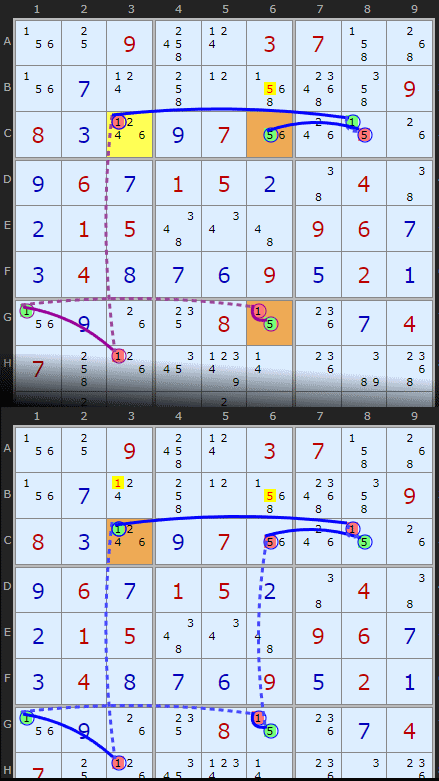
This type is quite difficult to find and comes from theory rather than practise. Perhaps it's my test stock that influences this, hard to tell. But I can only find examples if Alternating Inference Chains are turned off (in addition to Forcing Nets). AIC seem to snag the same eliminations as shown in this double diagram. This was the third out of nine AICs and you can seen the overlap. Exploring the other nine Digit Forcing Chains will also produce matches.
But lets dive into the example. C3 is the starting point and candidate 1 is considered ON and OFF.
When ON (purple) it heads south to -1[H3] and finishes on +5[G6]
+1[C3]-1[H3]+1[G1] -1[G6]+5[G6]
The OFF blue line gets to +5[C6]
-1[C3]+1[C8]-5[C8]+5[C6]
What we've achieved is certainty that either C6 or G6 must be 5 so other candidates in the column can be removed.
Often these Digit Forcing Chains will eliminate from a box as well, so check those.