
SudokuWiki.org
Strategies for Popular Number Puzzles
Unit Forcing Chains
If this is your first visit to these strategies, do read the article on Digit Forcing Chains which begins the explanation of this type of strategy and continues to with Cell Forcing Chains. Digit and Cell Forcing Chains are simpler to identify.
If we are forcing a result from a single cell we are obliged to look at all the numbers in that cell. But the logic can be flipped on its head by considering all of X on a unit. If you have three 8s on a row, you know one of those will be the solution. It may be possible to force an elimination by finding a target which can't be true no matter which of those 8s will it turns out to be.
If we are forcing a result from a single cell we are obliged to look at all the numbers in that cell. But the logic can be flipped on its head by considering all of X on a unit. If you have three 8s on a row, you know one of those will be the solution. It may be possible to force an elimination by finding a target which can't be true no matter which of those 8s will it turns out to be.
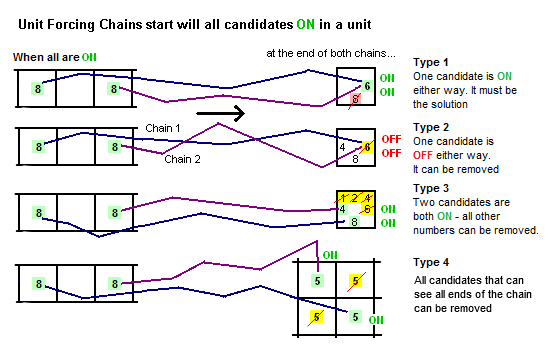
I do know of some Dual Unit Forcing Chains but they are part of such nightmarish puzzles I don't want to use them for examples. They are pretty rare considering that Alternating Inference Chains are sought after first. So we are going to plunge straight into a Triple.
Note: All these example can be found in the solver only by unchecking Forcing Nets
Type 2 - All chains lead to a candidate being OFF
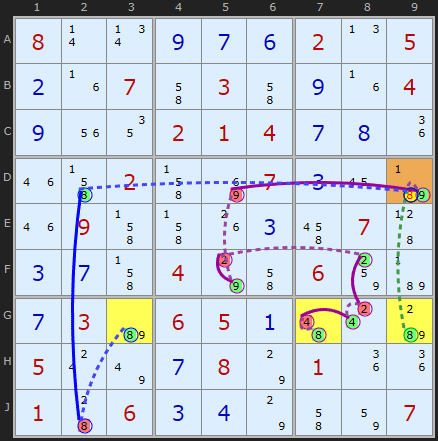
Three chains, the the shortest of which starts on G9 is in green. If G9 is ON then D9 is OFF.
To get to D9 from G3 involves three links. To -8[J2] to +8[D2] and finally -8D9
To find the final chain from G7 involves a bit more work:
+8[G7]-4[G7]+4[G8]-2[G8] +2[F8]-2[F5]+9[F5]-9[D5] +9[D9]-8[D9]
But gets there.
Type 3 - Candidates are confirmed in a Cell
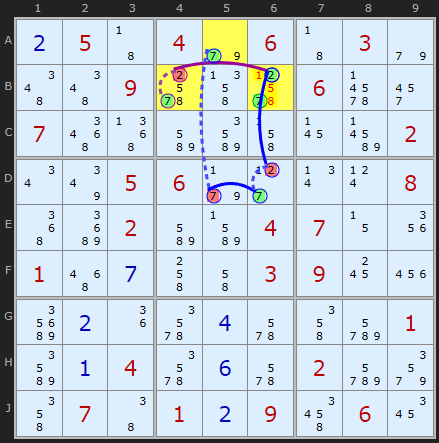
Quite hard to find Type 3 Unit Forcing Chain and they often double back on themselves so the chain ends are one of the starting cells. This is the case here were all the 7s in box 2 are considered to be ON in turn. What we find is that two of the chains confirm B6 should be 2 and while the +7 in B6 is its own assertion. Because we have accounted for all the 7s in the box the logic holds. 2 or 7 are the only options so all the other B6 candidates can be removed.
The chains are relatively short:
+7[A5]-7[D5]+7[D6] -2[D6]+2[B6]
+7[B4]-2[B4]+2[B6
Type 4 - All Candidates that can see the chain ends can be removed
A update in October 2025 allows a single digit in a unit to be a "chain" by turning it ON. This has permitted shorter and simpler chains in many instances.
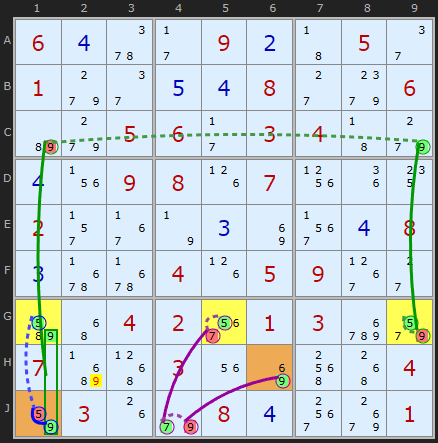
The example to the right is not too entangled. We have three 5s in row G on G1, G5 and G9. If any of these is the solution (and one has to be) we can show that H6 AND J1 must be 9. Any 9 that can see those to target cells can be removed, which is the 9 in H2 here.
The first chain in blue is short and obvious.
The second chain, purple, from G5 means no 7 in that cell so 7 must be in J4 (strong link) which forces 9 to be in H6. +5[G5]-7[G5]+7[J4] -9[J4]+9[H6].
The final chain, in green, also targets J1 confirming chain 1.
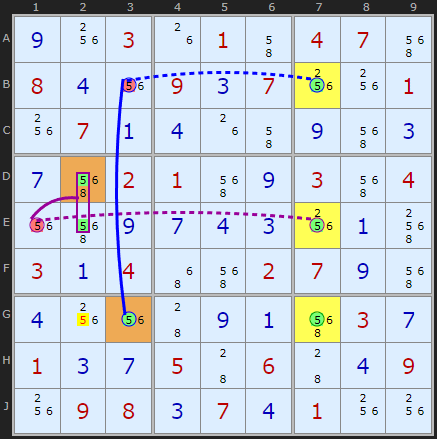
This second example +5 in G7 is one of the three 5s in column 7. The three chains are the shortest set of chains where we can ask "what 5 can see all the chain ends where 5 in ON. In this case G2 can see D2, G3 and G7.
Type 4: All three 5s in Col 7 make chains which end in +5, so candidates that can see all chain ends can be eliminated:
- 5 can be removed from G2
+5[B7]-5[B3]+5[G3]
+5[E7]-5[E1]+5[D2|E2]
+5[G7]
Comments
Email addresses are never displayed, but they are required to confirm your comments. When you enter your name and email address, you'll be sent a link to confirm your comment. Line breaks and paragraphs are automatically converted - no need to use <p> or <br> tags.
... by: robert
are you going to ever have a offline/ online version that can be bought??
My concern , like others, is that 5 years or so down the road, u will
lose interest in maintaining your databases and we will be unable to access this wonderful solver
I'm sure that there are many people like me that are more than willing
to pay for your solver and doc- I plan to be doing this the 20+ years
regards,
bob