
SudokuWiki.org
Strategies for Popular Number Puzzles
Grading Puzzles
As of the 1st of October 2025 I'm adopting a new scoring and grading system for Sudoku and variants. This is a potentially controversial topic so I though a page to explain it would be worth while. For four fifths of puzzles, roughly, the grade will be the same. This is not a new ball park and on a large scale a small difference. But on a case-by-case basis I think the new is more justified. What I'm hoping for is greater alignment with human solver's gut feel for a puzzle.
The Old Scheme
When I first thought about making puzzles I considered two aspects as being important. The strategies necessary to logically solve a puzzle and how many opportunities there were to spot a pattern or find a solution. The former is relatively easy to appreciate - there is a full spectrum of puzzle difficulty if you go beyond guessing. The second aspect is more subtle. Some puzzles collapse quite quickly. Others you have to chip away at candidate by candidate until you can break through, often multiple times.
In the old scheme I considered "rounds" which were based on finding solutions to cells. A new round started when you solved one or more cells. I created a weighting factor based on how strung out the solve path was. Each strategy used scored a number of points. I had points for candidates eliminated and extra points of these led to a solved cell. The sum of these points was multiplied by the weighting factor.
I also introduced a number of 'heuristics' – filtering rules which removed puzzles from the stock pool or promoted or demoted a puzzle by a grade. The most important one was recognising easy puzzles with a very hard bottleneck. The scoring system might give a puzzle a "tough" grade but it is trivial except for one or two 'diabolical' strategies in the middle. These are frustrating for puzzle solvers and we want to avoid them. Some puzzles might rack up a score with a dozen or so Pointing Pairs, say, but these are 'moderate' strategies.
Candidate Density
For the most part the old scheme was relatively successful. Although in the early years Fish strategies were over scored and boosted the difficulty rating. A Sword-Fish could eliminate a lot of candidates in one go, for example. I dialled back the scoring for these some years ago. But the other problem was that very hard puzzles that needed a lot of chains under scored. This didn't matter too much as most such puzzles ended up in the 'Extreme' category and didn't used in newspapers. These are interesting puzzles as they are the coal face for Sudoku theory and some people love to solve them.
The weighting factor based on 'rounds' has become difficult to maintain with so many puzzle variants. My recent insight in assessing the grading system is to look at candidate density - the total number of candidates on the board at any one step. More unsolved cells means more candidates to search for a pattern. The harder puzzles have more candidates per cell than simpler ones. This seems an ideal measure of the board.
This table is a typical solve path with the number of candidates from start to end.
| Step | Candidates C | F = C / 727 * 20 | |
| 2 | 219 | 6.0 | On a 9x9 board there are 727 total candidate slots. For Killer Sudoku all 727 are in play at the start. I create a factor by multiplying the fraction C/720 by 20. The factor F is multiplied by the points for that strategy. Since singles are common and easy and I further reduce their contribution by ignoring how many are found in the step and multiply by 1 and 2 for Naked and Hidden respectively. |
| 3 | 206 | 5.7 | |
| 4 | 185 | 5.1 | |
| 5 | 162 | 4.4 | |
| 6 | 148 | 4.1 | |
| 7 | 133 | 3.6 | |
| 8 | 123 | 3.4 | |
| 9 | 112 | 3.1 | |
| 10 | 102 | 2.8 | |
| 11 | 96 | 2.6 | |
| 12 | 93 | 2.6 | |
| 13 | 91 | 2.5 | |
| 14 | 84 | 2.3 | |
| 15 | 81 | 2.2 | |
| 16 | 77 | 2.1 | |
| 17 | 74 | 2.0 | |
| 18 | 72 | 2.0 | |
| 19 | 70 | 1.9 | |
| 20 | 68 | 1.9 | |
| 21 | 65 | 1.8 | |
| 22 | 62 | 1.7 | |
| 23 | 58 | 1.6 | |
| 24 | 54 | 1.5 | |
| 25 | 48 | 1.3 | |
| 26 | 39 | 1.1 | |
| 27 | 30 | 0.8 | |
| 28 | 19 | 0.5 | |
| 29 | 14 | 0.4 | |
| 30 | 8 | 0.2 |
Strategy Scores
In the old scheme points were awarded for eliminations + extra points for solving a cell. I have come round to the idea that if you have found a pattern then it doesn't really matter how many candidates are removed. Dropping this notion is one of the big changes in the new scheme and it should avoid fruitful strategies inflating a grade.
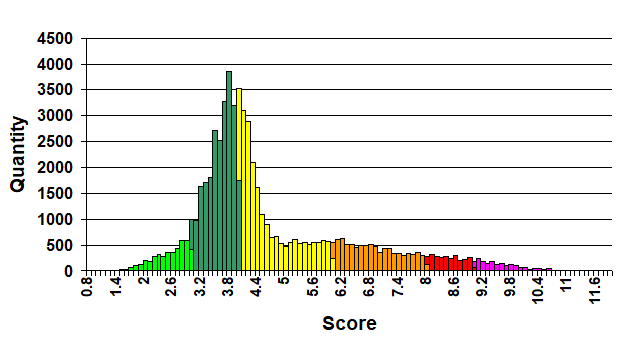
Now the sum of the scores for each step is the puzzle score. For vanilla Sudoku this gives a score from anywhere between 20 and 12,000+. To reduce any fixation on too many decimal places I normalize the score to a number between 1 and 10 with a log function.
9x9: Log5 (score) * 2
6x6: Log4 (score) * 2
Currently the division of the spectrum of puzzles into the named grades is as follows - and might change in the near future. Most randomly produced puzzles will be easy with extremes being the fewest.
6x6: Log4 (score) * 2
| Puzzle | Kids | Gentle | Moderate | Tough | Diabolical | Extreme |
| Sudoku | < 3 | 3 to < 4 | 4 to < 5 | 5 to < 7 | 7 to < 9 | 9+ |
| Sudoku X | < 4 | 4 to <5.5 | 5.5 to < 8 | 8 to < 10.5 | 10.5 to < 12 | 12+ |
| Jigsaw Sudoku | < 4.5 | 4.5 to < 7 | 7 to < 9 | 9 to < 10 | 10 to < 11 | 11+ |
| Killer Sudoku | x | <8.8 | 8.8 to < 9.2 | 9.2 to < 9.6 | 9.6 to < 10 | 10+ |
| Killer Jigsaw | x | <8.5 | 8.5 to < 9.5 | 9.5 to < 10 | 10 to < 10.5 | 10.5+ |
| KenKen 6x6 | x | <8.5 | 8.5 to < 9 | 9 to < 9.6 | 9.6 to < 10.5 | 10.5+ |
| Killer 6x6 | x | <6.3 | 6.3 to < 6.6 | 6.6 to < 7 | 7+ | x |
Points for other strategies:
| Jigsaw Strategies | score * factor |
| Double Pointing Pairs | 30 x F |
| Double Line/Box Reduction | 30 |
| Triple Line/Box Reduction | 50 |
| Law of Leftovers | 30 |
| Killer Strategies | score * factor |
| Trivial KenKen Dogleg | 10 |
| Killer Innies/Outies | 5 |
| Easy Combinations | 5 |
| Rule of Parity | 50 |
| Killer Cage Splitting | 40 |
| Killer Innies (2+ cells) | 30 |
| Cage/Unit Overlap | 60 |
| Hard Combinations | 10 |
| Killer Cage Comparison | 50 |
| KenKen Strategies | score * factor |
| KenKen Dogleg | 20 |
| Rule of 21 | 40 |
| Rule of 720 | 40 |
I have grouped strategies on the solver into 'tough', 'diabolical' and 'extreme' but it will be appreciated that the use of a particular strategy does not immediately make that puzzle belong to the grade the strategy is grouped in. I do try and filter away puzzles the score oddly and in the majority of cases the hardest strategy will be in the same group as the grade, but not always. I believe the new scheme pushes the spectrum further towards matching.
Comments and suggestions as ever always appreciated!
Many thanks to Andy Potvin for our discussions on this topic.
Andrew Stuart
Comments
Email addresses are never displayed, but they are required to confirm your comments. When you enter your name and email address, you'll be sent a link to confirm your comment. Line breaks and paragraphs are automatically converted - no need to use <p> or <br> tags.
... by: Southern Brit
As I said when we corresponded previously (I had a different handle), your Sudoku website is far and away the best.
I had taken a break from Sudoku, but now that I've retired I've started up again and I quickly realized that you had made changes to the site. It's even better than before.
I no longer use it to find the solution to puzzles I can't do, as I can now do essentially all the puzzles in the books I use, which are Frank Longo's Beyond (and Way Beyond) Black Belt Sudoku books. (I haven't tried your puzzles yet.)
These days I use the website to see how "you" would solve puzzles, which is frequently different from the way I do them. This is the result of having different opinions on how difficult the various strategies are.
For example, I think finned X-wings (and sashimi X-wings), hidden quads, and XYZ-wings are trivial to find; much easier than swordfish.
On the other hand, a 3D Medusa is virtually impossible if, like me, you use pen and paper, with no coloring and no lines drawn on the puzzle.
Talking of coloring, I think this maybe would be improved if you could break it down into the various patterns that "people" look for to find simple eliminations by that method. I'm talking about 2-string kites, turbot fish, and skyscrapers. A 2-string kite is a lot easier to spot than a chute remote pair, at least for me, and certainly easier than a rectangle elimination - for which I always have an alternative.
I looked at your example 2 for rectangle elimination, and I would see a 2-string kite. I look in each block for any digit which is present in more than one row and column. Block 8 has a 9 in G6, J4, and J6. Are there strong links from these to 9s in other blocks, one going vertically and the other going horizontally? Yes. J4 has a strong link to F4, and G6 has a strong link to G2. Therefore, if F4 IS a 9, then F2 cannot be a 9, If F4 is NOT a 9, then J4 must be a 9, in which case G6 cannot be a 9, and then G2 must be a 9, and F2 cannot be. This is really simple to visualize without coloring or drawing lines, even though it takes a couple of sentences to describe.
I know all of the above is only partly relevant to the big picture of how you rate individual puzzles, but since the scores assigned to individual strategies play a part, I thought I'd give some feedback on the latter.
Best wishes, and thanks again,
Martin.
I have made an effort to move some of the shorter, simpler versions of higher strategies to be closer to the top. UR-1 is very simple and was wasted hanging out in the diabolical section. There is a case for short X-Cycles. If you turn off Rectangle Elimination you get to this X-Cycle which is exactly the pattern you describe. However the way the strategy is documented doesn’t start by looking at a box in the way you say which is more helpful for the 2-string kite, if that is what it is.
Perhaps it is an accident of what I found all those years ago, or perhaps people started with Kites and said “no you can generalise and get more if you extend it this way”. I already have too many in the list! But there is a case short patterns like.
... by: Christian Gengenbach
I thought this is a good place to mention the obversation that Ute and I have since a long time. This is about the rating of the Killer Sudokus, which are of in our view off since a long time and still are also with the new rating system. Now we didn’t go into the theory behind it, so this is just a feeling from playing your puzzles (mainly Killer, Jigsaw and Kakuro almost every day).
We have for a long time (many months, years even?) we experience that the easy and moderate Killer Sudokus are usually harder than tough or diabolical. We also think there was a moment in time where this suddenly changed - it was ok before that moment.
I’m sorry we can’t provide you with more details, beside “just a feeling”. However we would be interested if there are other players out there with the same feeling.
Thanks a bunch for your great puzzles and work!
Ute and Christian.
That’s concerning and I do want to fix it. I have had some similar comments but I need to look up if that was other people. But not many.
I think the main change I might have made in the last couple of years is the ‘easy combo’ clearance. Originally I took this a cage at time but the solve path became tedious and extended as this step was often called being early and easily triggered. Now I bunched up to ten eliminations in however many cages. I figured removing candidates not present in any combo was a pretty easy win.
Perhaps it is the scoring and I should look at the values again, although they have been pretty static
Can you send me a link to the next tough/diab that you found easy and a one to a hard easy/moderate?
Even better would be a hard tough/diab and an easy easy/moderate. So four data points. I don’t know what a valid sample is but might be able to draw some conclusions. No rush, just as and when you can.
... by: Rosie
I’d like to offer an SE rating myself but I understood it to mean “the highest rated strategy used in the solve path” based on a lookup table. If I’m wrong send me to an algorithm for SE ratings and I’ll include it. If it is magically very close to my assessor I might convert entirely.
... by: KerryRogers
... by: Pieter Newtown, Oz
Wow, you've been busy this year with upgrades!!! 😲
I note your new scoring system - interesting. I got stuck on the recent puzzle for July 11th. Originally presented as a Diabolical puzzle but on the old grading system rated as Extreme/Very Hard 343. Extreme is usually too hard for me, but 343 not that hard. I've regularly done puzzles in the 400s & some 500s (876 my highest). So why was I stuck on a 343?
I used the solver to get past a few WXYZs I had missed then continued solving till I succeeded. Then I read about your new grading and found that this particular puzzle is now graded as a 10.7 - almost off the top of the Extreme level!!! No damn wonder I got stuck!!! Though I "should" have spotted the WXYZs.
I wouldn't consider it to have been a "high level" Extreme, but it was a "long" / Very Hard type. Personally I would rate it as a low level Extreme (GXCs, AICs).
Just my thoughts.
Ciao, Pieter 🙂