
SudokuWiki. rg
rgStrategies for Popular Number Puzzles
Captured Candidates

An example is provided on the right. 8+ in a 3-cage can be 1-2-5 or 1-3-4. Since 1 is necessary in both it can't exist elsewhere on the row.
Captured Candidates + Hidden Pairs/Triples will eliminate the same candidates as KenKen Combinations + Naked Pairs/Triples. They are two sides of the same coin. It is arbitrary which comes first but there has to be one order.
Cage Unit Overlap as used later will compute the candidates based not just on the clue and cage size but what candidates remain after other eliminations. This can be quite hard to do mentally so it is down the list.
Cage Hidden Singles
Here is an interesting situation with the yellow cage with seven cells at the bottom of the board. 'Captured Candidates' is going to find something first and call it a Cage Hidden Single. This board A to the right. This cage has seven remaining candidates spread over seven cells making it a locked set. But 4 exists only once in the cage in J4. As a 4 is necessary there being 7 for 7 in the cage, we must assume 4 is the solution for J4.
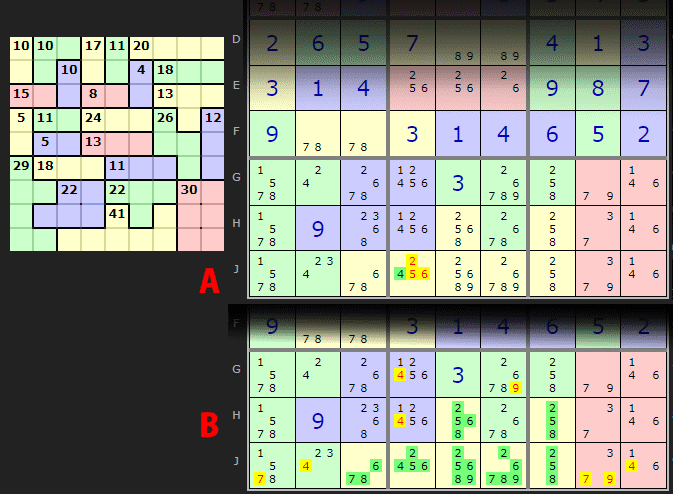
If this was a cage with 4 cells it would be a Naked Quad but we don't go that high for cages of size 7. Unticking 'Captured Candidates' gives us another view on the cage (B) using Cage/Unit Overlap. It identifies it as a locked set and starts to remove all other candidates that can see all of each N in the cage. The single 4 is "pointing" to all 4s it can see just as you'd expect from a single. Trace the other eliminations.
Link to example
Comments
Email addresses are never displayed, but they are required to confirm your comments. When you enter your name and email address, you'll be sent a link to confirm your comment. Line breaks and paragraphs are automatically converted - no need to use <p> or <br> tags.